
LB Nagar is located at the south-eastern corner of Hyderabad, where the Inner Ring Road meets the Vijayawada highway. It is the eastern terminus of the metro’s Red Line, one of the city’s most affordable well-connected addresses, and almost entirely absent from the coverage the western corridor gets.
This article explains what property actually costs here, why the advertised price sits nearly 29% above what people really pay, the dip in the price record that no one talks about, and whether the affordability is worth the trade.
The short answer
LB Nagar is where you buy if you want a metro station, a hospital and a school within walking distance for well under a crore. On that measure, very little in Hyderabad competes.
Two things to understand before you start looking.
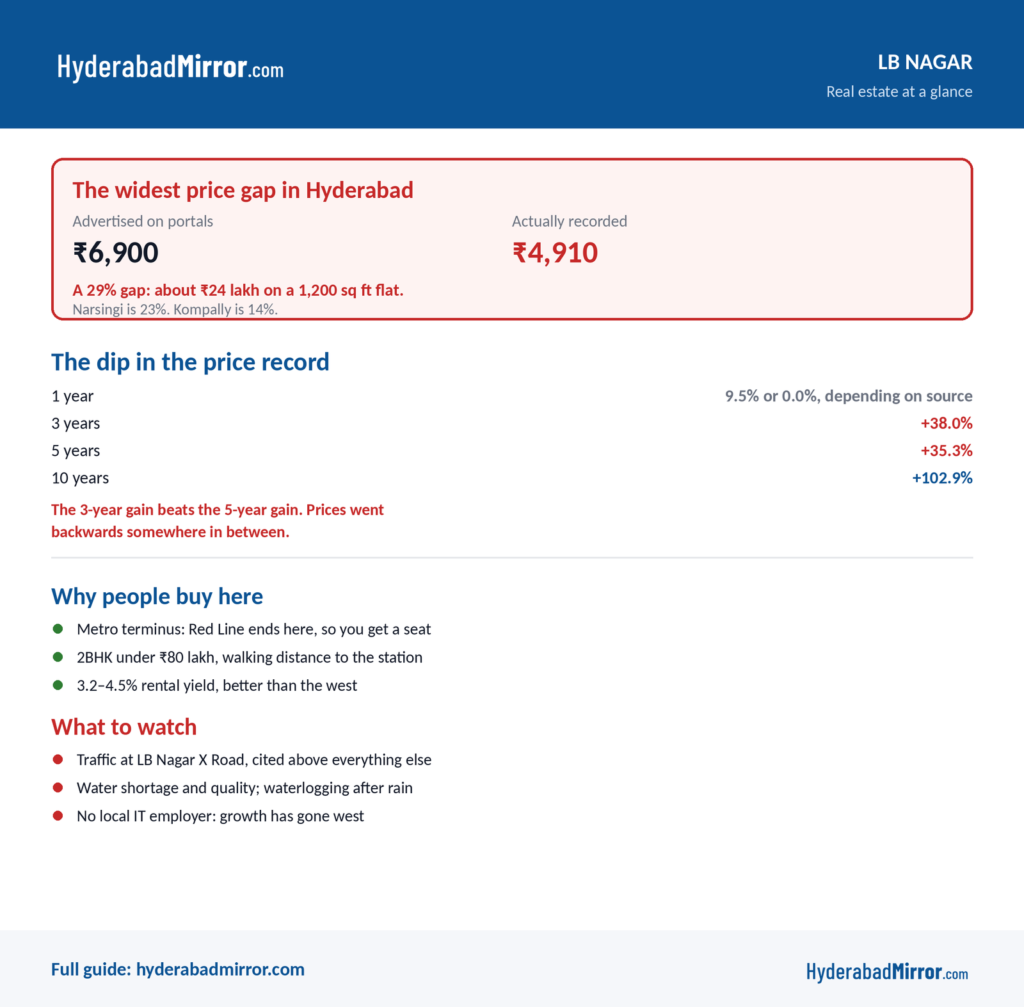
The advertised rate is nearly 29% above the recorded one. Portals show around ₹6,900 per square foot. Government transaction records average ₹4,910. That is roughly ₹24 lakh on a 1,200 square foot flat, and it is the widest gap of any Hyderabad locality we have measured.
And the growth story has a dip in it. The three-year gain is larger than the five-year gain, which is arithmetically only possible if prices went backwards somewhere in between. The section below explains what happened.
If you want value, connectivity and a home you will actually live in, LB Nagar is a serious option. If you want the returns the western corridor has produced, this is not that market, and the honest reason is below.
What property costs in LB Nagar

Published figures for 2026:
- Flats: roughly ₹5,200 to ₹9,200 per square foot, with published averages between ₹6,650 and ₹6,900
- Land: roughly ₹7,600 to ₹13,550 per square foot
- Independent houses: government records put actual transactions at about ₹3,973 per square foot
In whole-property terms: a 2BHK runs from about ₹55 lakh to ₹80 lakh. A 3BHK typically falls between ₹85 lakh and ₹1.5 crore. The broad market spans roughly ₹84 lakh to ₹3 crore, with the occasional outlier listing far above that.
Watch the total cost: A flat listed at ₹75 lakh reaches about ₹81 lakh once you add registration at 7.5%, plus parking, and the first year’s maintenance.
The 29% gap between advertised and actual prices
This is the most useful thing to know about LB Nagar, and it is larger here than anywhere else in the city.
There are two averages for LB Nagar flats, and they do not agree:
- The asking rate: about ₹6,900 per square foot. This is compiled from what owners and brokers advertise.
- The government transaction rate: about ₹4,910 per square foot. This is the average of prices actually recorded at registration, taken from state revenue data.
That is a gap of nearly 29%. On a 1,200 square foot flat, the difference between the advertised rate and the recorded average works out to about ₹24 lakh.
For comparison, the same gap runs around 23% in Narsingi and 14% in Kompally. LB Nagar is the widest we have found.
Why so wide? Two reasons, and neither is dishonesty. Asking prices are what sellers hope for, and in a buyer’s market they get negotiated down harder. And LB Nagar’s stock is mixed: a new gated tower and a twenty-year-old walk-up both sit under the same locality name, but only the newer ones get advertised on portals.
What to do about it: treat ₹6,900 as a ceiling, not a going rate. The recorded average tells you what your neighbours actually paid, and it is the stronger number to negotiate from.
LB Nagar price appreciation: the dip in the record
Here is the published record for flats:
| Period | Change |
|---|---|
| 1 year | 9.5% (one source), 0.0% (another) |
| 3 years | 38.0% |
| 5 years | 35.3% |
| 10 years | 102.9% |
Read the three and five year rows again. The three-year gain is bigger than the five-year gain.
That is not a typo, and it is not possible in a market that only goes up. It means prices in LB Nagar were flat or falling between roughly four and five years ago, then recovered strongly in the last three. Buyers who bought at the wrong point in that window waited years to get back to level.
The one-year figures disagree completely: one source reports 9.5% growth, another reports exactly 0.0%. When the recent numbers contradict each other that sharply, the honest reading is that the market is flat right now, and the recovery of the last three years has run its course for the moment.
In rupees: ₹50 lakh in an LB Nagar flat ten years ago would be worth about ₹1 crore today. Respectable, and roughly a third of what the same money did in Kokapet over a comparable period.
Rental yield in LB Nagar: what you’ll earn
Yields run 3.2% to 4.5%, which is towards the better end for Hyderabad and better than the western corridor manages.
In real money: on a ₹75 lakh flat, that is roughly ₹20,000 to ₹28,000 a month.
The reason is straightforward. Prices here have not run away from rents the way they have in Kokapet or Narsingi, so the arithmetic still works. Tenant demand comes from the metro rather than a local employer: people who work elsewhere and want a short commute at a price they can afford.
The honest read: LB Nagar is one of the few Hyderabad areas where the rental maths is genuinely reasonable rather than a rounding error.
Why buy in LB Nagar? The advantages
- The metro terminus. LB Nagar is the eastern end of the Red Line, with Victoria Memorial and Chaitanyapuri stations nearby. A terminus means you get a seat, and it means the line is not going to be extended past you and dilute your position.
- Genuine affordability. Sub-₹80 lakh gets you a 2BHK in a gated community with a metro station in walking distance. That combination has largely disappeared from the west.
- Roads in every direction. The Inner Ring Road, the Outer Ring Road, and NH-65 to Vijayawada all meet here.
- Mature social infrastructure. Kamineni and Gleneagles AWARE hospitals, D-Mart, malls, established schools, and markets that have been there for decades. Nothing here is still being promised.
- It is finished. Unlike the western corridor, LB Nagar is not a construction site. The trees are grown, the roads exist, the shops are open.
- Residents rate it highly, ranking it 35th of 744 Hyderabad localities, with affordability, healthcare and transport cited most often.
Disadvantages of buying in LB Nagar
The reviews are blunt, and consistent.
Traffic is the defining complaint. Residents describe it as horrific at peak hours. LB Nagar X Road is a junction the whole south-east passes through, and long-distance buses to Vijayawada stop there at night, which compounds it. Flyovers and underpasses have helped, but the volume keeps growing.
Water shortage, and quality. Multiple residents report both. Supply is inconsistent in parts, and the water that arrives is not always good.
Power cuts, reported as frequent and often at night.
Waterlogging. The area floods after heavy rain, and drainage has not kept pace.
Pollution. Traffic and nearby industrial activity both contribute. One local group put it starkly: residents can buy water and food, but they cannot buy clean air.
Street-level neglect. Potholes, footpaths occupied by vendors, missing street lights, no dustbins, irregular waste collection, and limited police patrolling all recur across reviews.
And the structural one: the east gets overlooked. This is worth saying plainly because it affects your investment, not just your commute. Hyderabad’s growth, its IT campuses, its lake developments and its CSR money have gone west. LB Nagar has no equivalent employment engine, and there is not a single internationally recognised school in the area. Even a developer analysis of the market concedes that limited institutional developer interest and the western corridor’s dominance of IT absorption cap the upside here, and that buyers should expect steady, inflation-plus returns rather than outsized gains.
That is an unusually honest thing to find on a site that sells property here, and it matches the price record above.
Which corporation is LB Nagar under? Tax and approvals
LB Nagar sits in Rangareddy district and falls under GHMC, in the city’s south-eastern zone. Circles here include LB Nagar itself, with Saroornagar, Mansoorabad and Hayathnagar nearby.
After the February 2026 reorganisation of Greater Hyderabad into three corporations, confirm which body now handles approvals, property tax and complaints for your specific pocket rather than assuming it is unchanged.
Confirm the property has a clear property tax identification number (PTIN) with no arrears before you buy, since unpaid tax transfers to you along with the property.
Before you pay any booking amount
- Negotiate from the recorded rate, not the asking rate. The 29% gap is the widest in the city. Ask what comparable flats in the building actually registered at.
- Water, in writing. Municipal supply, borewell, or tankers? What does the society spend? Shortage and quality are both live complaints here.
- RERA registration. Verify the number on the official TSRERA portal, not the brochure.
- Occupancy Certificate for ready flats. Never take possession without one.
- Age of the building. LB Nagar has a lot of older stock. A twenty-year-old walk-up and a new gated tower are priced under the same locality average but are not the same asset.
- Encumbrance Certificate, confirming no loans or ownership disputes.
- Visit at peak hour. The traffic is the single most-cited complaint. Judge it yourself at 6pm on a weekday, not at noon on a Sunday.
- Check the monsoon record of the specific street. Waterlogging is localised and the seller will not raise it.
- A property lawyer before you pay anything.
Is LB Nagar a good investment? The verdict
If you’re buying a home to live in: yes, and it is one of the better value propositions in Hyderabad. Metro, hospitals, schools and markets, all finished, for under a crore. Go in knowing about the traffic.
If you’re a rental investor: yes, comparatively. 3.2% to 4.5% beats the western corridor, because prices here have not detached from rents.
If you want capital growth: modest, and be honest with yourself about why. There is no local employment engine, institutional developers have stayed away, and even a seller’s own analysis calls for inflation-plus returns rather than outsized gains. ₹50 lakh became ₹1 crore over ten years here, against roughly ₹1.5 crore in the west.
If you’re a short-term flipper: no. The one-year figures say flat, the three-versus-five-year record shows this market can go sideways for years, and registration alone costs 7.5%.
[LISTINGS BLOCK: paste into ONE Shortcode block; replace with your real verified listings]
Frequently asked questions
What is the price of flats in LB Nagar in 2026?
Published figures run from about ₹5,200 to ₹9,200 per square foot, with averages quoted between ₹6,650 and ₹6,900. However, government transaction records put the actual average at about ₹4,910 per square foot, so the price paid is typically well below the advertised rate. A 2BHK runs roughly ₹55 lakh to ₹80 lakh.
Why is the advertised price so much higher than the actual price in LB Nagar?
The gap is nearly 29%, the widest in the city. Asking prices reflect what sellers hope for and get negotiated down, and LB Nagar’s housing stock is mixed: new gated towers get advertised while older buildings, which pull the recorded average down, mostly do not.
Is LB Nagar a good investment?
For living in and for rental yield, yes. It offers metro connectivity, mature infrastructure and genuine affordability, with yields of 3.2% to 4.5%. For capital growth it is modest, because there is no local employment engine and development attention has gone to the western corridor.
What is the rental yield in LB Nagar?
About 3.2% to 4.5%, or roughly ₹20,000 to ₹28,000 a month on a ₹75 lakh flat. That is better than the western corridor, where prices have run further ahead of rents.
What are the disadvantages of living in LB Nagar?
The most cited are severe peak-hour traffic at LB Nagar X Road, water shortage and poor water quality, frequent power cuts, waterlogging after rain, air pollution from traffic and industry, and street-level neglect including potholes and irregular waste collection.
Did property prices in LB Nagar ever fall?
The published record suggests so. Flat prices show a 38% gain over three years but only 35.3% over five, which is only arithmetically possible if prices were flat or falling somewhere in the intervening period. One-year figures currently disagree, with one source reporting 9.5% and another 0.0%.
Is LB Nagar connected by metro?
Yes. It is the eastern terminus of the metro’s Red Line, with Victoria Memorial and Chaitanyapuri stations nearby. This is the area’s strongest asset and the main reason tenant demand holds up.
Which corporation does LB Nagar come under?
LB Nagar is in Rangareddy district and falls under GHMC’s south-eastern zone. Following the February 2026 reorganisation, confirm which body handles your specific pocket for approvals, tax and complaints.
Figures are indicative for 2026, compiled from public market data, government transaction data and resident reporting, and vary by project, street, floor and age of building. This is general information, not investment advice. Verify current prices, RERA status, approvals and tax dues yourself before buying, and consult a property lawyer.