
Miyapur sits at Hyderabad’s north-western edge, where the metro’s Red Line ends and the Mumbai highway begins. It is the affordable half of the western corridor: twenty minutes from HITEC City by metro, and a fraction of what Kokapet or Gachibowli cost.
This guide explains what property actually costs here, why the published figures disagree more than in any other Hyderabad locality, what the water situation really is, and whether the metro premium is worth paying.
The short answer
Miyapur is where the western corridor becomes affordable without becoming remote. A metro terminus, the ORR, NH-65, and HITEC City twenty minutes away, for roughly half the price of Kokapet.
Two things before you start looking.
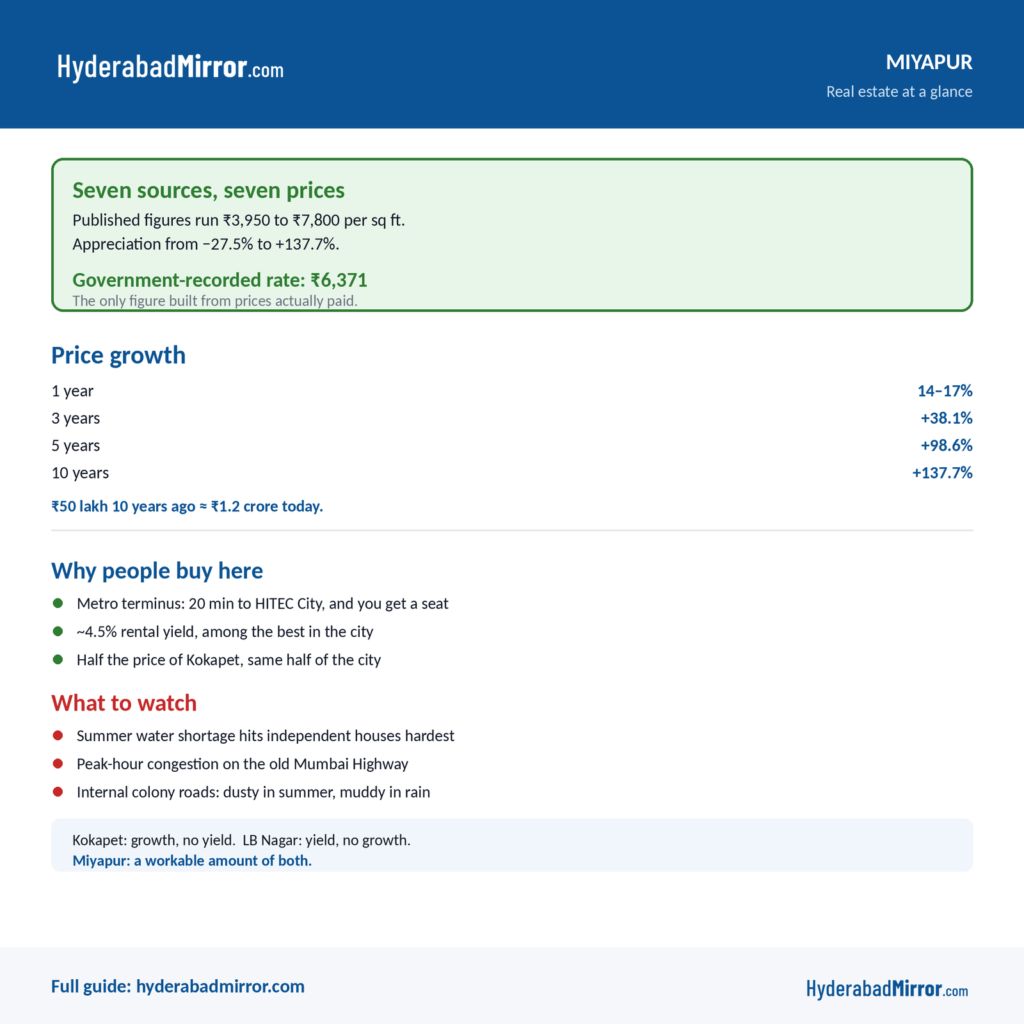
The published prices disagree wildly. Different sources put Miyapur flats at ₹3,950, ₹5,500 to ₹7,500, ₹6,550 to ₹6,900, ₹7,250, ₹7,500 and ₹7,800 per square foot. The appreciation figures are worse: one source reports a 27.5% fall over its tracked period while another reports a 137.7% rise over ten years. Both cannot describe the same market.
The government transaction rate cuts through it. Recorded sales average ₹6,371 per square foot for flats and ₹4,891 for independent houses. That is the number your neighbours actually paid.
If you want a metro-connected home in the west without western-corridor prices, Miyapur is the strongest option in the city. If you are buying on the appreciation figures, read the section on why they conflict first.
What property costs in Miyapur

Published figures for 2026:
- Flats: roughly ₹5,700 to ₹8,500 per square foot, with quoted averages between ₹6,550 and ₹7,800
- Government-recorded flat transactions: about ₹6,371 per square foot
- Independent houses, recorded: about ₹4,891 per square foot
- Land: roughly ₹6,700 to ₹13,350 per square foot
- Builder floors: roughly ₹5,350 to ₹6,550 per square foot
In whole-property terms: a 1BHK starts around ₹30 lakh. A 2BHK runs ₹60 lakh to ₹1.2 crore, with older stock from about ₹41 lakh. A 3BHK falls between ₹90 lakh and ₹1.5 crore. The market spans roughly ₹41 lakh to ₹2.5 crore.
Miyapur has volume that most localities do not: over 900 properties listed for sale, 36 apartment projects, and around 1,671 ready-to-move flats. You have genuine choice here, which matters for negotiation.
Watch the total cost. A flat listed at ₹70 lakh reaches about ₹75.5 lakh once you add registration at 7.5%, plus parking and the first year’s maintenance.
Why the published prices disagree so much
Miyapur has the widest spread of published figures of any Hyderabad localities, and it is worth understanding before you use any of them.
Per square foot figures published for Miyapur flats in 2026:
| Source type | Figure |
|---|---|
| A locality analysis site | ₹3,950 |
| A market report | ₹5,500 to ₹7,500 |
| A listing portal | ₹6,550 to ₹6,900 |
| Another portal average | ₹7,250 |
| A locality overview | ₹7,500 |
| Another portal | ₹7,800 |
| Government-recorded transactions | ₹6,371 |
The appreciation figures conflict even more sharply. One source reports -27.5% over its tracked period. Another reports +137.7% over ten years, +98.6% over five and +16.9% over one. A third reports 14% over a year, a fourth 2 to 3% a year.
Why the spread is so wide here. Miyapur is large and genuinely mixed. It covers older independent houses in colonies like HMT Swarnapuri, mid-segment apartments from the 2000s, and new gated launches on the Gachibowli corridor. Ameenpur village on its edge is budget housing. A figure built from new-launch listings and a figure built from all recorded sales are measuring different halves of the same postcode.
What to do about it. Anchor on the government-recorded rate of ₹6,371, because it is the only figure derived from what people actually paid rather than what sellers asked. Then adjust for the specific building’s age and location. Locality averages are close to meaningless in an area this varied.
The metro terminus, and why it matters more here
Miyapur is the western terminus of the metro’s Red Line. LB Nagar is the eastern one. Everything in between is a middle station.
Being a terminus has two practical effects worth understanding before you compare it to a middle station.
You board an empty train. At a terminus, the train starts there. During the morning peak that is the difference between a twenty-minute seated commute to HITEC City and standing for the same journey from a middle station.
Your position will not be diluted. A middle station can be bypassed when a line extends. A terminus stays the end of the line unless the whole corridor is rebuilt.
There is a third effect worth naming honestly: the depot is here. Miyapur houses the metro depot, which is why the terminus landed here in the first place. That anchored the area’s development, and it also means a large tract of land near you will never be residential.
Trains run to HITEC City in about twenty minutes, and to Ameerpet, the interchange for the whole network, without changing.
Miyapur price appreciation: what the record shows
The five-year figure is roughly double the ten-year annualised rate, so most of Miyapur’s growth is recent rather than steady. It brackets the metro’s maturation and the post-pandemic IT hiring surge.
Setting aside the outlier figures, the pattern most sources agree on:
| Period | Flat price change |
|---|---|
| 1 year | 14% to 16.9% |
| 3 years | 38.1% |
| 5 years | 98.6% |
| 10 years | 137.7% |
Unlike LB Nagar, the sequence here is internally consistent: each longer period shows a larger gain, which is what a steadily rising market looks like.
In rupees: ₹50 lakh in a Miyapur flat ten years ago would be worth about ₹1.2 crore today.
The five-year figure of 98.6% is the interesting one. It brackets the metro’s maturation and the post-pandemic IT hiring surge, and it is roughly double the ten-year rate, which suggests most of Miyapur’s growth is recent rather than steady.
Forward projections cluster at 8 to 10% a year, with a base case of ₹8,000 to ₹9,000 per square foot by 2030. Those come from sources selling here, so treat them as the optimistic end rather than the expectation.
Rental yield in Miyapur: what you’ll earn
Yields run about 4.5%, which is towards the top of the Hyderabad range and considerably better than the western corridor manages.
In real money: a 2BHK rents for ₹14,000 to ₹20,000 a month, with the wider range across property types running ₹8,000 to ₹40,000. On a ₹70 lakh flat, ₹26,000 a month is roughly 4.5%.
The demand is structural rather than speculative. Miyapur is the residential catchment for HITEC City, Gachibowli, Kondapur and the Financial District, and the metro is what makes that work. Tenants who cannot afford Kondapur rents but need a reliable commute end up here.
The honest read: this is one of the few Hyderabad areas where both the yield and the capital growth are reasonable at the same time. Kokapet gives you growth without yield. LB Nagar gives you yield without growth. Miyapur gives you a workable amount of both.
Why buy in Miyapur? The advantages
- The metro terminus, with a seated twenty-minute commute to HITEC City and a direct run to Ameerpet.
- Roads in every direction: NH-65 to Mumbai, the Outer Ring Road, and the Miyapur to Gachibowli corridor.
- Genuine affordability in the west. Roughly half of Kokapet, in the same half of the city.
- Volume, and therefore choice. Over 900 properties for sale and around 1,671 ready-to-move flats. You are not choosing between three options.
- Established retail and schools. GSM Mall, Manjeera Mall, and several large schools and hospitals within a few kilometres. Nothing here is still being promised.
- Both yield and growth. About 4.5% rental yield alongside 98.6% five-year appreciation is an unusual combination.
- Residents rate connectivity 4.3 out of 5 and safety 4.1, which is high for an outer suburb.
Disadvantages of buying in Miyapur
Peak-hour traffic on the highway. The old Mumbai Highway congests badly during office hours, and the junctions around Miyapur are pinch points. The commute to HITEC City by road is slow enough that the metro is not really optional.
Summer water shortage. Residents report supply problems concentrated in the summer months, and Miyapur has appeared on official lists of areas reporting shortage. The distinction that matters: gated communities with their own storage and rainwater harvesting mostly cope; independent houses do not. If you are buying an independent house here, budget for extra storage tanks.
Internal roads and dust. Colony roads are inconsistent, dusty in dry months and muddy after rain. The main roads are fine; the lanes behind them often are not.
Occasional power cuts, reported as minor but regular.
Drainage and parking come up repeatedly as civic concerns that could hold back near-term price momentum.
Limited public transport inside the colonies. The metro serves the main road well, but sub-localities like Ameenpur and Ganesh Nagar are not within walking distance of a station, and residents there depend on private vehicles.
It is not a workplace. Miyapur is a residential catchment, not an employment centre. Your commute is structural, not temporary.
Which corporation is Miyapur under? Tax and approvals
Miyapur sits in the north-western zone and falls under GHMC, with the pincode 500049. Parts of the surrounding belt, including Ameenpur, fall under different local bodies, so the boundary matters more here than in a central locality.
After the February 2026 reorganisation of Greater Hyderabad into three corporations, confirm which body handles approvals, property tax and complaints for your specific pocket rather than assuming.
Confirm the property has a clear property tax identification number (PTIN) with no arrears before you buy, since unpaid tax transfers to you along with the property.
Before you pay any booking amount
- Anchor on ₹6,371, not the asking rate. That is the government-recorded average. Ask what comparable flats in the building actually registered at.
- Age of the building. Miyapur’s stock spans thirty years. A 2005 apartment and a 2025 gated tower sit under the same locality average and are not the same asset.
- Water, in writing. Gated community with storage and harvesting, or an independent house on borewell? This is the single biggest practical difference in Miyapur.
- Which local body? Miyapur comes under Cyberabad Municipal Corporation, but the surrounding belt is not uniformly so. Confirm for your exact address.
- RERA registration, verified on the official TSRERA portal, not the brochure.
- Occupancy Certificate for ready flats. Never take possession without one.
- Encumbrance Certificate, confirming no loans or ownership disputes.
- Walk to the metro station and time it. “Near the metro” covers everything from a two-minute walk to a five-kilometre drive.
- A property lawyer before you pay anything.
Is Miyapur a good investment? The verdict
If you’re buying a home to live in: yes, and it is arguably the best value in west Hyderabad. Metro, malls, schools and hospitals, all finished, at half the western-corridor price.
If you’re a rental investor: yes. About 4.5% is among the better yields in the city, and tenant demand is structural rather than speculative.
If you want capital growth: reasonable. 98.6% over five years is real, though most of it is recent. Forward projections of 8 to 10% come from sellers, so temper them.
If you’re a short-term flipper: no. Registration alone is 7.5%, and the published one-year figures span 2% to 17% depending on who you ask, which is not a basis for timing an exit.
The comparison that matters: Kokapet gives growth without yield. LB Nagar gives yield without growth. Miyapur is the one area in this set that offers a workable amount of both.
Frequently asked questions
What is the price of flats in Miyapur in 2026?
Published figures range from about ₹5,700 to ₹8,500 per square foot, with quoted averages between ₹6,550 and ₹7,800. Government-recorded transactions average ₹6,371 per square foot, which is the more reliable anchor since it reflects prices actually paid. A 2BHK runs roughly ₹60 lakh to ₹1.2 crore.
Why do different websites show such different prices for Miyapur?
Because Miyapur is large and mixed. It spans older independent houses, mid-2000s apartments and new gated launches on the Gachibowli corridor. A figure built from new-launch listings and one built from all recorded sales measure different halves of the same postcode. Anchor on the recorded rate.
Is Miyapur a good investment?
For both living and renting out, yes. It offers roughly 4.5% rental yield alongside 98.6% five-year price appreciation, which is an unusual combination in Hyderabad. The main cautions are summer water shortage for independent houses and peak-hour highway traffic.
What is the rental yield in Miyapur?
About 4.5%, among the better yields in Hyderabad. A 2BHK typically rents for ₹14,000 to ₹20,000 a month, and the wider range across property types runs ₹8,000 to ₹40,000.
Is there a water problem in Miyapur?
Shortage is reported, concentrated in summer. The practical distinction is between gated communities, which generally have their own storage and rainwater harvesting and cope reasonably well, and independent houses, which do not. If you buy an independent house, budget for extra storage.
How far is Miyapur from HITEC City?
About twenty minutes by metro on the Red Line. By road during office hours it is considerably longer, which is why the metro matters here rather than being a convenience.
Why does being a metro terminus matter?
Two reasons. Trains start at Miyapur, so you board an empty one and get a seat during peak hours. And a terminus cannot be bypassed by a future extension the way a middle station can.
What are the disadvantages of living in Miyapur?
The most cited are peak-hour congestion on the old Mumbai Highway, summer water shortage affecting independent houses more than gated communities, inconsistent internal colony roads, occasional power cuts, and limited public transport inside sub-localities away from the main road.
Figures are indicative for 2026, compiled from public market data, government transaction data and resident reporting, and vary by project, sub-locality, age of building and floor. This is general information, not investment advice. Verify current prices, RERA status, water arrangements, approvals and tax dues yourself before buying, and consult a property lawyer.