Shamshabad loacetd on Hyderabad’s southern edge, built around the Rajiv Gandhi International Airport. In two decades it has gone from farmland to one of the city’s most talked-about plot markets, cheaper than the western corridor, with an airport-led growth story that gets promoted hard.
This guide explains what property actually costs here, why the published prices disagree by more than three times, the land regulation that can stop you building on a plot you’ve already paid for, and what residents report about living here.
The short answer
Shamshabad is a genuine long-term land play, and it’s affordable compared with Gachibowli, Narsingi or Kokapet. Two things deserve your attention before anything else.
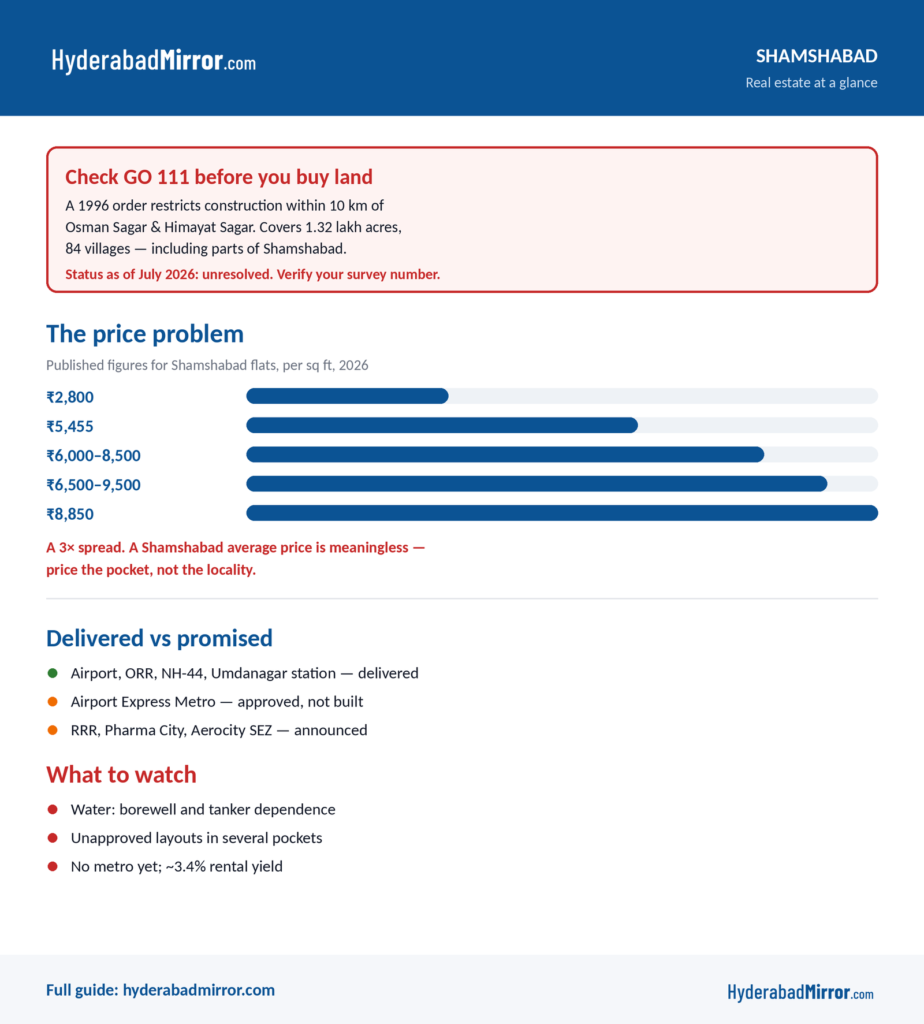
First, parts of Shamshabad fall under GO 111, a 1996 government order restricting construction near the Osman Sagar and Himayat Sagar lakes. Its legal status is currently unresolved. If your plot is inside the catchment, what you’re allowed to build on it is an open question. This is the most important check in this area, and it isn’t optional.
Second, the published prices vary by more than three times. One source puts Shamshabad flats at ₹2,800 per square foot and another at ₹8,850. Same locality name, same year.
If you’re buying land to hold for 7-10 years and you verify the regulation first, Shamshabad can work. If you want a home for a daily commute into the city, look closer in.
What flats and plots cost in Shamshabad

Published figures for 2026 sit in these ranges:
- Flats / apartments – roughly ₹4,800 to ₹9,500 per square foot, depending on the source and the pocket
- Plots / land – enormously variable, from budget layouts on the outer edges to premium gated plots near the airport
- Villas – premium gated villa projects generally start around ₹1.5 crore and climb well beyond
In whole-property terms: the market spans roughly ₹40 lakh at the entry end to over ₹9 crore for large villas and premium land. That range is unusually wide for a single locality name, and the reason matters, it’s the next section.
Watch the total cost: A flat listed at ₹70 lakh can reach ₹80–84 lakh once you add registration and stamp duty, GST on under-construction units, parking, club membership and the first year’s maintenance. Ask for the all-in figure before comparing anything.
Why the published prices disagree so much
This is the first thing to understand about Shamshabad, and it isn’t a small discrepancy.
Per-square-foot figures published for Shamshabad flats in 2026 include:
- About ₹2,800
- From about ₹5,455
- About ₹6,000 to ₹8,500
- About ₹6,500 to ₹9,500
- An average of about ₹8,850
That’s a spread of more than three times between the lowest and highest, for the same locality in the same year.
They can all be partly right, and the reason is geography. “Shamshabad” gets used loosely. It covers the municipality proper, the villages around it, the airport-adjacent premium ventures and outlying farmland, sources even cite different pincodes for it. A figure measuring older independent houses in a village pocket and a figure measuring new gated plots near the airport are describing genuinely different markets that happen to share a name.
What this means for you: a Shamshabad “average price” is close to meaningless. Ignore locality averages here and price the specific pocket, the specific layout and the specific approval status. More than anywhere else in Hyderabad, the exact location within Shamshabad decides the price.
GO 111: the land regulation that can stop you building
This is the most important…
What GO 111 is. In March 1996, the then-undivided Andhra Pradesh government issued Government Order 111. It prohibits polluting development, industries, residential colonies, hotels, within a 10 kilometre radius of the Osman Sagar and Himayat Sagar reservoirs, to protect their catchment. It covers roughly 1.32 lakh acres across 84 villages, in mandals that include Shamshabad, Rajendranagar, Moinabad, Chevella and Shabad.
Inside the catchment, land use is heavily restricted. The order classifies about 90% of the area for recreation and conservation, and requires roughly 60% of any layout to remain open space and roads.
Why its status is unresolved. In 2022 the state cabinet decided to revoke GO 111, on the reasoning that Hyderabad no longer depends on the two lakes for drinking water. But the Supreme Court had upheld GO 111 in 2000, applying a “precautionary principle” when an industrial unit sought to operate inside the catchment and legal experts argued that scrapping the order would conflict with that judgement.
As of mid-2026 the position still hasn’t settled. Officials are reported to be examining a partial withdrawal — lifting the restriction only for areas inside the Outer Ring Road, rather than everywhere.
What this means if you’re buying here. Not all of Shamshabad is affected, GO 111 applies to specific villages in the catchment, not the whole mandal. But if your plot is inside it:
- What you’re permitted to build may be far less than the seller implies
- The rules could move in either direction while you hold the land
- Some layouts in these villages have been marketed despite the restrictions
Before you pay anything for land in Shamshabad, establish in writing whether the survey number falls inside the GO 111 catchment. Ask the seller directly, check with HMDA, and have a property advocate confirm it independently. A layout being advertised or even partly built, is not evidence that it’s permitted.
Shamshabad price appreciation: what the record shows
Long-run land appreciation across the southern corridor has been real, driven by the airport and the ORR. But the near-term figures published for Shamshabad are as inconsistent as the prices themselves, one portal reports a year-on-year apartment change above 30%, while broader commentary on Hyderabad’s peripheral corridors projects roughly 10 to 15% a year.
Given the three-times spread in the underlying price data, treat any single Shamshabad appreciation percentage as unreliable. A growth figure only means something if you know which pocket it measures and whether it’s built from asking prices or recorded sales.
The more useful way to think about it: Shamshabad’s future value depends almost entirely on infrastructure that is promised rather than delivered. So it’s worth separating the two.
The catalysts, honestly assessed
These get promoted heavily. Here’s what’s real and what’s still on paper:
Delivered:
- Rajiv Gandhi International Airport – operational, and the anchor of the entire area
- ORR and NH-44 access – genuinely excellent; the ORR now carries roughly 1.6 lakh vehicles a day
- Umdanagar railway station – operational
Approved but not built:
- Metro Phase 2 / Airport Express – the central government has approved an extension connecting the airport and the Old City. This is the single biggest potential change for Shamshabad. It is approved, not operational.
Announced or in progress:
- Airport expansion towards handling 34 million passengers a year
- Regional Ring Road (RRR)
- Pharma City employment hub
- Aerocity SEZ commercial development
Every one of these is a genuine reason the area could grow. None is a reason to pay today for value that doesn’t exist yet. The gap between “approved” and “operational” in Hyderabad infrastructure has historically been measured in years, and you don’t control the timeline.
Rental yield in Shamshabad: what you’ll earn
Rents here run roughly ₹8,000 to ₹20,000 a month for typical properties, affordable relative to the western corridor, which cuts both ways, because it’s also what you’d earn as a landlord.
In real money: on a ₹70 lakh flat, ₹20,000 a month is a yield of about 3.4%. Broader Hyderabad yields run 3.8 to 5%, so Shamshabad sits at the lower end, unless you’re renting to the aviation and hospitality workforce, where demand is steadier.
The honest read: Shamshabad is a land-appreciation play, not a rental-income play. Buy it for what the land might be worth in a decade, not for the monthly cheque.
Best areas in Shamshabad to buy (Satamrai, Mamidipally & more)
The pocket matters more here than anywhere else, because price, approvals and daily life all change within a few kilometres:
- Shamshabad town / bus stand area – the established core, best connected by road and bus, but the noisiest and most congested
- Satamrai – a busy plotted-development belt with several large gated layouts
- Mamidipally – residential, schools nearby, more settled
- Gollapally, Ootpally, Tondapally, Kothwalguda – villages within the municipality; cheaper, more variable infrastructure
- Airport-adjacent premium ventures – the top of the market, gated plots and villas
Some pockets carry a specific reputation for unapproved layouts – residents and local reporting have named Kapugadda, RB Nagar and Mission Compound. That doesn’t make every layout there unapproved, but it does mean the approval check matters more, not less.
Why buy in Shamshabad? The advantages
- Cheaper than the western corridor for comparable land and homes
- Excellent road connectivity – the airport, ORR and NH-44 all meet here, and residents rate connectivity highly
- The airport is a permanent anchor – it isn’t moving, and it keeps generating aviation, logistics and hospitality employment
- Space and calmer surroundings – lower density than central Hyderabad, a pleasant climate, more open land
- Real infrastructure momentum – even discounting the promises, the airport and ORR are substantial
- A large plotted-land market, if buying land rather than a flat is your strategy
Disadvantages of buying in Shamshabad
Resident reviews and local reporting are consistent about these:
Water supply is a genuine problem. Residents report a lack of safe drinking water, heavy dependence on borewells, and buying drinking water by the can. Some pockets rely on private tankers. Ask any property you consider about its water source and what it costs each month.
Traffic and air pollution. The airport area congests badly at peak hours. Residents cite frequent jams and air pollution from the sheer volume of vehicles, with poor air quality readings in parts of the area.
No metro yet. The Airport Express is approved, not built. Until it opens, this is a car-dependent location and the commute into the city is long.
Safety after dark varies sharply by pocket. Several residents describe roads that are dark and lonely after sunset with limited police patrolling; others rate the area safe. Visit at night before you buy.
Drainage, garbage and encroachment. Local reporting notes an absence of proper drainage, irregular garbage collection in parts of RB Nagar and Siddeswara Colony, and unchecked encroachment near Jalpally Lake causing waterlogging.
Unapproved layouts. Beyond GO 111, local reporting has identified unapproved layouts in several pockets. This is the practical reason approval is the first item on the checklist below.
Which body governs Shamshabad? Tax, approvals & jurisdiction
Shamshabad sits in Rangareddy district, in the Rajendranagar revenue division. Its civic jurisdiction is worth confirming rather than assuming.
Shamshabad was a Gram Panchayat before being constituted as a municipality, covering Shamshabad, Gollapally, Ootpally, Tondapally, Kothwalguda and Satamrai. Separately, GHMC operates a Shamshabad Zone within its own zonal structure. After the February 2026 reorganisation of Greater Hyderabad into three corporations, boundaries in the outer areas are still settling.
So confirm in writing which body handles approvals, property tax and complaints for the exact pocket you’re buying in. This isn’t a formality here, it determines who issues your building permission, who collects your tax, and where a grievance goes. Ask the seller, then verify independently rather than taking the answer on trust.
Also confirm the property has a clear property tax identification number (PTIN) with no arrears, unpaid tax transfers to you along with the property.
Before you pay any booking amount
- GO 111 status: establish in writing whether the survey number falls inside the Osman Sagar / Himayat Sagar catchment. The most important check in this area, by a distance.
- Layout approval: confirm HMDA approval and verify the LP number independently. Several pockets have a documented history of unapproved layouts.
- Which civic body: municipality or GHMC zone? Confirm for your exact pocket.
- Encumbrance Certificate: confirms no loans, disputes or ownership conflicts.
- RERA registration (for projects): verify on the official TSRERA portal, not the brochure.
- Occupancy Certificate (for flats): never take possession without it.
- Water source and cost: borewell, tanker dependency, drinking water. A bigger issue here than most areas.
- Visit after dark: safety and lighting vary sharply between pockets.
- A property lawyer: specifically to check land classification and GO 111 applicability before you pay.
Is Shamshabad a good investment? The verdict
If you’re buying land to hold 7 to 10 years: this is Shamshabad’s real case. The airport is permanent, the ORR is delivered, and the metro extension is approved. Verify GO 111 and the layout approval, then be patient.
If you’re buying a home to live in: it depends entirely on your job. For anyone working in aviation, logistics, hospitality or the wider airport ecosystem, it’s a sensible and affordable choice. For a daily commute to HITEC City or the Financial District, the distance and the absent metro make it hard.
If you’re a rental investor: modest. Roughly 3.4% on typical numbers, at the lower end of the Hyderabad range. This isn’t a yield play.
If you’re a short-term flipper: no. The price data is too inconsistent to price an exit, and the regulatory position is unresolved. Land here rewards patience, or punishes impatience.
Frequently asked questions
What is the price of property in Shamshabad in 2026?
Published figures vary enormously — from about ₹2,800 to ₹8,850 per square foot depending on the source and the pocket. That spread is real, because “Shamshabad” covers everything from village-edge houses to premium airport-adjacent gated ventures. Price the specific pocket, not the locality average.
What is GO 111 and does it affect Shamshabad?
GO 111 is a 1996 government order restricting construction within 10 km of the Osman Sagar and Himayat Sagar lakes, covering about 1.32 lakh acres across 84 villages in mandals including Shamshabad. Parts of Shamshabad fall inside it. The state cabinet moved to revoke it in 2022, but the Supreme Court had upheld it in 2000, and as of mid-2026 officials are still examining a partial withdrawal for areas within the ORR. The status is unresolved — verify whether your specific survey number is affected.
Is Shamshabad a good place to invest?
For long-term land holding it has a genuine case: the airport is permanent, the ORR is delivered, and a metro extension is approved. The cautions are the unresolved GO 111 position, documented unapproved layouts in some pockets, and water supply problems.
What is the rental yield in Shamshabad?
Rents typically run ₹8,000 to ₹20,000 a month, which works out to roughly 3.4% on a ₹70 lakh flat — the lower end of the Hyderabad range. Shamshabad is a land-appreciation play rather than a rental-income one.
What are the disadvantages of living in Shamshabad?
The most cited are unreliable water supply with borewell and tanker dependence, traffic congestion and air pollution near the airport, no operational metro yet, dark and poorly patrolled roads in some pockets after dark, and drainage and garbage problems in parts of the area.
Is it safe to buy a plot in Shamshabad?
It can be, with proper checks. Two risks apply here more than elsewhere: whether the plot falls inside the GO 111 catchment, and whether the layout is genuinely HMDA approved — local reporting has identified unapproved layouts in several pockets. Confirm both in writing, get the Encumbrance Certificate, and use a property advocate.
When will the metro reach Shamshabad?
The central government has approved a Metro Phase 2 extension connecting the airport and the Old City. It is approved, not operational, and no reliable opening date should be assumed. Treat it as a possibility rather than a delivered amenity when pricing property.
Which corporation does Shamshabad come under?
Shamshabad is in Rangareddy district and was constituted as a municipality covering Shamshabad, Gollapally, Ootpally, Tondapally, Kothwalguda and Satamrai. GHMC also operates a Shamshabad Zone. Following the February 2026 reorganisation, confirm in writing which body handles approvals, tax and complaints for your exact pocket.
Figures are indicative for 2026, compiled from public market data and local reporting, and vary enormously by pocket, layout and approval status. The GO 111 position described here was accurate as of July 2026 and is subject to change. This is general information, not legal or investment advice. Verify current prices, RERA status, layout approval, GO 111 applicability, civic jurisdiction and tax dues yourself before buying, and consult a property lawyer.