Kokapet is at Hyderabad’s western edge, above the Outer Ring Road and minutes from the Financial District. In seven years it has gone from open land at ₹4,000 a square foot to Hyderabad’s most expensive residential address, with land auctioning at ₹60–75 crore an acre.
This guide explains what property actually costs here, why the published prices vary by more than double, what you’ll spend on water each month, and whether the premium is worth paying.
The short answer
Kokapet is Hyderabad’s luxury benchmark and the fundamentals are real, the Financial District is 4–6 km away with 65,000+ jobs, the ORR is at the doorstep, and a metro extension is sanctioned.
Two things deserve your attention first.
The published prices aren’t comparing the same thing. You’ll see ₹8,200 and you’ll see ₹17,500 for the same locality. Much of that gap isn’t the market, it’s that premium projects quote carpet area while portals quote super built-up. Get this wrong and you’ll misjudge a flat by 30%.
And the water. Significant parts of Kokapet still aren’t connected to the piped network. Tanker dependence runs ₹6,000–15,000 a month, in a flat that cost you three crore.
If you’re buying to live near the Financial District and you can absorb the running costs, Kokapet delivers. If you’re buying purely on the appreciation story, read the pricing section first.
What property costs in Kokapet

Published figures for 2026:
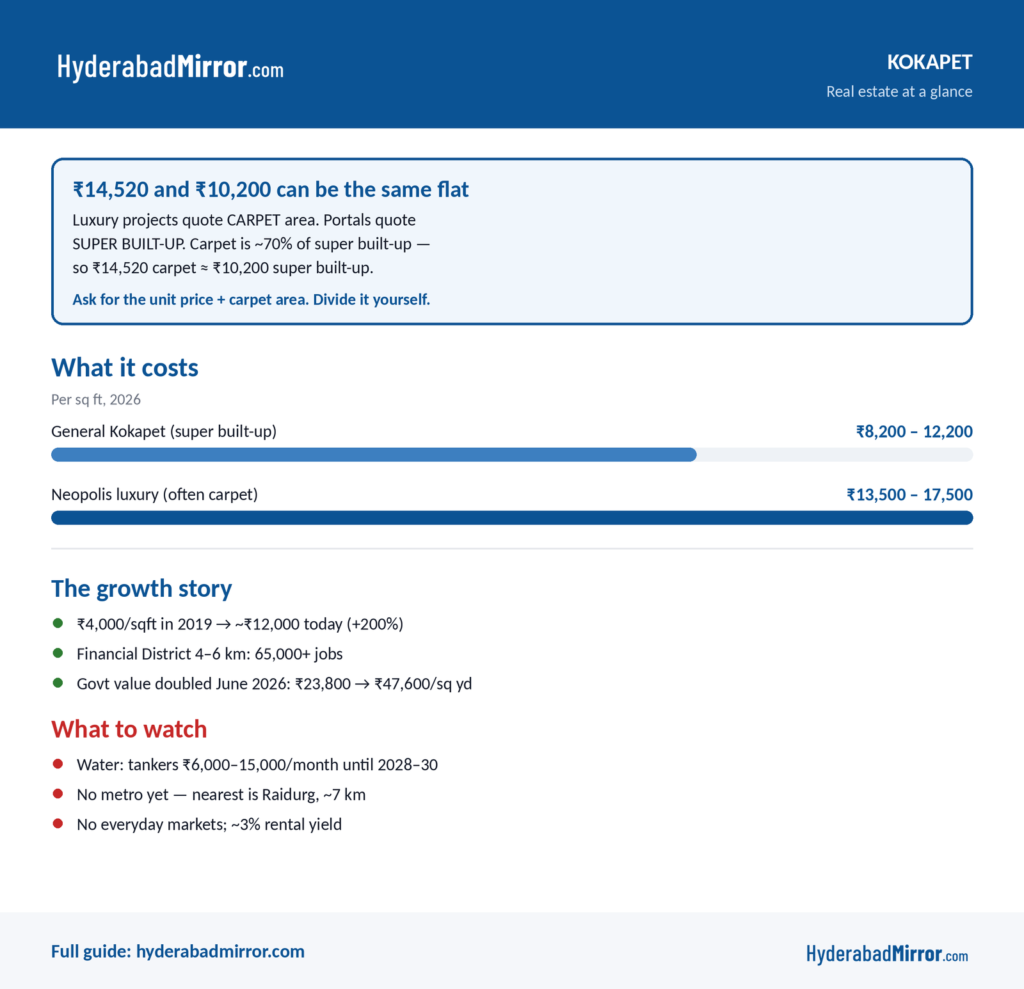
- Flats, general Kokapet: roughly ₹8,200 to ₹12,200 per square foot
- Flats, Neopolis and new luxury launches: roughly ₹13,500 to ₹17,500 per square foot
- Land: auctioning at ₹60–75 crore per acre, with some sources reported above ₹100 crore
In whole-property terms: a 2BHK starts around ₹1.3 crore. A 3BHK runs ₹2–3 crore. Premium 4BHKs reach ₹4.5 crore, and the ultra-luxury towers go well beyond, some offer units from 3,065 to 9,860 square feet across 57 floors.
Watch the total cost: A ₹2.5 crore flat reaches roughly ₹2.7 crore once you add registration at 7.5%, plus parking, club membership and the first year’s maintenance. And in Kokapet, add the water bill below.
Why the prices disagree: carpet area vs super built-up
This is the most useful thing to understand before you compare a single project.
A flagship Neopolis tower launched at ₹14,520 per square foot on carpet area. Portals list Kokapet at ₹8,200-12,200 per square foot, on super built-up area.
Those are not the same measurement, and the difference is large.
- Carpet area is the floor you can actually walk on, inside your walls.
- Super built-up area adds your share of the corridors, lobby, staircase, lift shafts and amenities.
Carpet is typically around 70% of super built-up. So ₹14,520 per square foot of carpet works out to roughly ₹10,200 per square foot of super built-up, right inside the portal range.
The luxury projects aren’t 40% more expensive than the portals suggest. They’re quoting a smaller number of larger-value feet.
What to do about it: never compare two projects on rate alone. Ask both for the same measurement or better, ask for the total price of the specific unit and divide by the carpet area yourself. That’s the only number that means anything across builders.
Kokapet or Neopolis? They aren’t the same place
The names get used interchangeably and they shouldn’t be.
Kokapet is the broader locality, roughly 4.5 sq km, bounded by the ORR to the south, Manchirevula east, Khajaguda north, Tellapur west.
Neopolis is a specific HMDA master-planned enclave inside it: a 49-acre layout across seven parcels in survey numbers 239 and 240, classified as a Special Development Zone under the HMDA Master Plan 2031. The government put ₹300 crore into trunk infrastructure and completed it in 18 months.
Neopolis is where the record land auctions happened from 2021, and where the ultra-luxury towers are. It prices 20–40% above general Kokapet. When someone quotes you a “Kokapet rate”, ask which one they mean.
Kokapet price appreciation: what the record shows
The long-run numbers are genuinely striking, and unusually consistent across sources:
- About ₹4,000 per square foot in 2019, now around ₹12,000 today. Roughly 200% in seven years.
- 100% over the last five years, per portal data
- 40% over the last three years
Forward projections cluster at 12–18% a year, though those come mostly from developers selling here, treat them as the optimistic end.
In rupees: ₹50 lakh put into a Kokapet flat in 2019 would be worth about ₹1.5 crore today.
The driver is not speculation, it’s the Financial District maturing next door. Over 8 million sq ft of Grade-A office space sits within 2 km, with another 4 million coming by 2028–29.
The government value doubled in June 2026
This one directly affects your registration bill, and Kokapet was hit harder than anywhere.
On 5 June 2026 Telangana revised official property values. Kokapet land went from ₹23,800 to ₹47,600 per square yard, exactly double. No other area in the revision moved that far.
Duty is charged on the higher of your sale price or the government value, at 7.5% total. So if you were buying near the old government value, your registration cost has roughly doubled too.
Our guide to the June 2026 land value revision explains how to calculate what you’ll now pay.
Rental yield in Kokapet: what you’ll earn
Rental demand is genuinely strong, Financial District professionals want to live within a 10-minute commute, and several owners report exactly that.
But yields sit around 3%, which is the arithmetic of any luxury market: prices have run far ahead of rents. On a ₹2.5 crore flat, that’s roughly ₹62,000 a month.
The honest read: Kokapet has been a capital-appreciation story, not a yield story. Buy it for what it’s worth in a decade, and treat the rent as a contribution to your maintenance and water bill.
Disadvantages of buying in Kokapet
The reviews are consistent, and one of them costs real money.
Water is the big one – Significant portions of Kokapet still aren’t connected to HMWSSB’s piped network, the utility’s own service-area maps show it. Supply depends on tankers.
A 5,000-litre load costs ₹800 to ₹1,400 depending on season. A family of four typically needs two to three loads a week. That’s ₹6,000 to ₹15,000 a month, before the piped connection arrives, and HMWSSB’s expansion reports target full coverage in these zones only by 2028–2030.
Borewells are not the escape. The rocky western geology around Kokapet yields lower recharge than areas further east, and borewells here have been known to run dry within a few years.
Traffic at the ORR exit – Residents consistently cite jams at the Kokapet exit and interchange at peak hours.
No metro yet – The nearest station is Raidurg, about 7 km away. The Phase 2 Blue Line extension to Neopolis via Biodiversity Junction, Khajaguda and the Financial District is sanctioned, not built the window is 2027-2029.
No everyday shopping – This is the most-repeated complaint after water: no street markets, no vegetable bazaars, few affordable local shops. One resident put it plainly, the area lacks basic shops, which made daily life frustrating. You drive for groceries.
Construction dust and noise – Much of Kokapet is a building site and will be for years.
Poor street lighting, stray dogs, no walking tracks, and no nearby police station appear repeatedly in resident reviews, surprising for the price point.
High running costs – Maintenance in these towers is substantial, and it compounds with the tanker bill.
Why buy in Kokapet? The advantages
- The Financial District is 4–6 km away – 65,000+ jobs across Wells Fargo, Deloitte, EY, JP Morgan, Microsoft and Accenture, with 8 million sq ft of Grade-A office within 2 km
- Direct ORR access at Exit 1, plus the Trumpet Interchange at Neopolis
- Genuinely planned infrastructure – wide roads, underground utilities, dedicated green zones, unusual for Hyderabad
- Metro sanctioned – Blue Line extension to Neopolis, if it lands on schedule
- Elevated terrain with Osman Sagar and Kokapet Lake views
- Strong schools and hospitals – AIG, Continental, Silver Oaks, Phoenix Greens, and the ISB nearby
- The best builders are all here – Brigade, Godrej, My Home, Prestige, Rajapushpa, Aparna
- Airport 28.8 km – via the ORR
Which body governs Kokapet? Tax and approvals
Kokapet comes under Rangareddy district, governed by Cyberabad Municipal Corporation (CMC) and HMDA, with Neopolis specifically an HMDA-planned Special Development Zone.
After the February 2026 re-organisation of Greater Hyderabad into three corporations, boundaries in the outer western belt are still settling. Confirm which body handles approvals, property tax and complaints for your specific pocket rather than assuming.
Also confirm the property has a clear property tax identification number (PTIN) with no arrears, unpaid tax transfers to you with the property.
Before you pay any booking amount
- Which area measurement? Get the rate on carpet and super built-up, or the total unit price plus the carpet area. Comparing rates across builders without this is meaningless.
- Water, in writing. Is the project connected to HMWSSB piped supply, or on tankers? What does the society currently spend per month? This is the biggest hidden cost in Kokapet.
- RERA registration – verify on the official TSRERA portal, not the brochure.
- Occupancy Certificate for ready flats, never take possession without it.
- Kokapet or Neopolis? Confirm which, because the pricing differs by 20–40%.
- Encumbrance Certificate – confirms no loans or ownership disputes.
- All-in cost – 7.5% registration on a ₹2.5 crore flat is roughly ₹19 lakh. Add parking, club, maintenance.
- Completion date and the builder’s record. Several towers here complete in 2028-29. Check what else that builder has delivered on time.
- A property lawyer before you pay anything.
Is Kokapet a good investment? The verdict
If you’re buying to live near the Financial District: yes, if the running costs don’t bother you. Nothing else in Hyderabad puts you this close to that many jobs with this quality of planning.
If you want capital appreciation: the record is the strongest in the city, 200% in seven years. But you’re buying at the top of that curve, not the bottom. The next decade won’t repeat the last.
If you’re a rental investor: weak. ~3% yield is poor, and the tanker bill eats into it. Look east or north for yield.
If you want value: no. Tellapur costs 18% less and Narsingi 27% less, for similar Financial District access. You’re paying for Neopolis planning and the address.
If you’re a short-term flipper: no. Registration alone is 7.5%, most inventory completes in 2028-29, and you’d need substantial appreciation just to break even.
Frequently asked questions
What is the price of flats in Kokapet in 2026?
Roughly ₹8,200 to ₹12,200 per square foot on super built-up area for general Kokapet, and ₹13,500 to ₹17,500 for Neopolis luxury launches, but those luxury figures are often quoted on carpet area, which is about 70% of super built-up. Always confirm which measurement you’re being given.
What is carpet area versus super built-up area?
Carpet area is the floor inside your walls that you can actually use. Super built-up adds your share of corridors, lobby, lifts and amenities. Carpet is typically around 70% of super built-up, so ₹14,520 per sq ft of carpet is roughly ₹10,200 per sq ft of super built-up, the same flat, a different number.
Is Kokapet a good investment?
For capital appreciation the record is exceptional: about 200% over seven years, driven by the Financial District. But you’re buying near the top of that run, yields are only around 3%, and the running costs are high. It’s a long-hold, live-in proposition rather than a quick gain.
What is the water situation in Kokapet?
Significant parts still aren’t on HMWSSB piped supply, so many homes rely on tankers at ₹800–1,400 per 5,000-litre load, typically ₹6,000–15,000 a month for a family of four. HMWSSB targets full coverage by 2028–2030. Ask any project for its water source in writing.
What are the disadvantages of living in Kokapet?
The most cited are tanker dependence and its cost, traffic at the ORR exit, no operational metro (nearest is Raidurg, ~7 km), the absence of everyday markets and affordable local shops, construction dust, and poor street lighting.
Is Kokapet the same as Neopolis?
No. Neopolis is a 49-acre HMDA master-planned Special Development Zone within Kokapet, where the record land auctions took place. It prices 20–40% above general Kokapet.
When will the metro reach Kokapet?
A Phase 2 Blue Line extension from Raidurg to Kokapet Neopolis has been sanctioned, running via Biodiversity Junction, Khajaguda and the Financial District. It’s approved, not built, the expected window is 2027-2029, and no date should be assumed when pricing property.
How much did the government value rise in June 2026?
Kokapet land doubled, from ₹23,800 to ₹47,600 per square yard, the sharpest increase in the state revision. Since duty is charged at 7.5% on the higher of your price or the government value, this can substantially raise your registration cost.
Figures are indicative for 2026, compiled from public market data, government transaction data and resident reporting, and vary by project, tower, floor and facing. This is general information, not investment advice. Verify current prices, the area measurement being quoted, RERA status, water supply arrangements, approvals and tax dues yourself before buying, and consult a property lawyer.