Narsingi loacted at Hyderabad’s western edge, right beside the Financial District and the Outer Ring Road. Over the last decade it’s gone from a quiet village to one of the city’s busiest housing markets and prices have climbed steeply.
This guide explains what flats and plots actually cost here, why the advertised price is higher than what people really pay, the downsides worth knowing before you buy, and the one land-approval check that matters more in Narsingi than in most areas.
The short answer
Narsingi has been one of Hyderabad’s premium and fast growing areas, but two things deserve your attention before you buy.
First, the advertised price and the actual sale price are far apart. Listings show around ₹10,300 per square foot, but government-recorded transactions average about ₹7,942. That’s a real gap, and it’s money.
Second, some parts of Narsingi is on revenue land, plots that may not have proper layout approval. Getting this checked isn’t optional here.
If you’re buying a home to live in near the Financial District and you verify the paperwork properly, Narsingi is a solid choice. If you’re buying purely on the headline growth figures, read the section on why those figures disagree first.
What flats and plots cost in Narsingi

As of 2026, here’s the range:
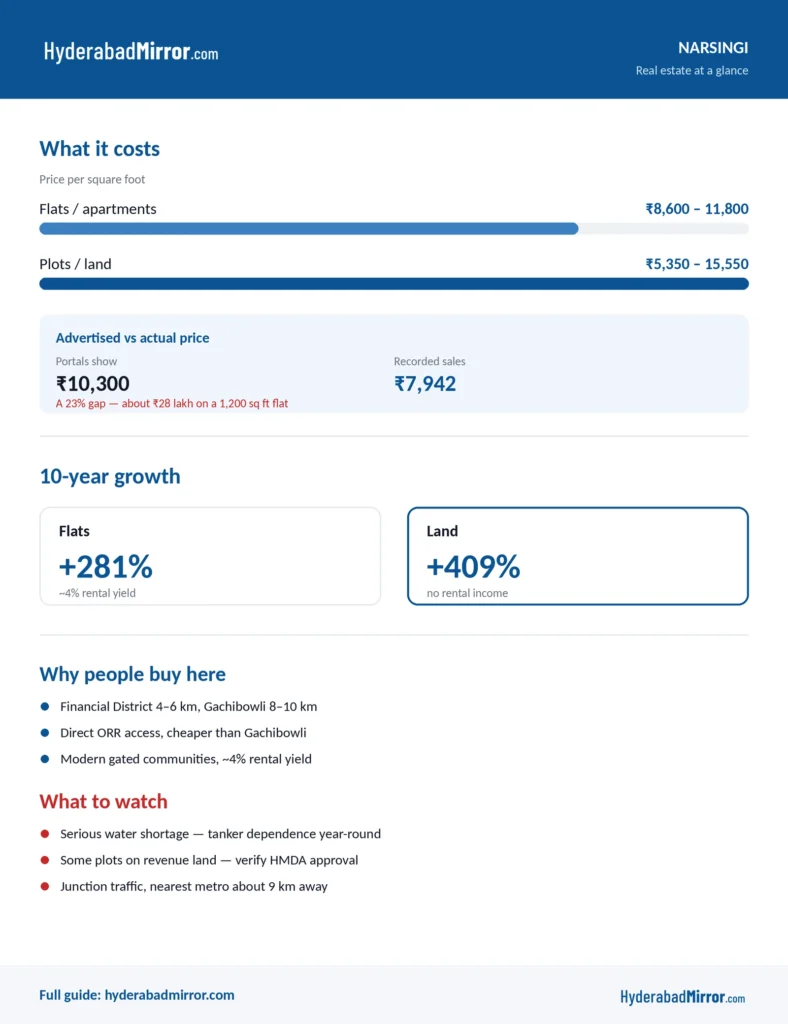
- Flats / apartments: roughly ₹8,600 to ₹11,800 per square foot
- Plots / land: roughly ₹5,350 to ₹15,550 per square foot, depending heavily on the pocket
- Builder floors: roughly ₹4,950 to ₹10,800 per square foot
In whole-property terms: a 2BHK flat runs from about ₹85 lakh to ₹1.4 crore. A 3BHK typically falls between ₹1.6 crore and ₹2.6 crore. Villas and larger units climb well beyond that, some premium listings cross ₹10 crore.
But watch the total cost, not just the rate. A flat listed at ₹1.5 crore can reach ₹1.75–1.85 crore once you add registration and stamp duty, GST (on under-construction flats), parking, club membership and the first year’s maintenance. Always ask for the all-in figure before you compare two projects.
Why the advertised price is higher than what people actually pay
This is the most useful thing to understand about Narsingi before you start comparing prices.
There are two different “average prices” for Narsingi, and they don’t match:
- The asking rate: about ₹10,300 per square foot. This is what sellers and brokers advertise on property portals.
- The government transaction rate: about ₹7,942 per square foot. This is the average of prices actually recorded at registration, from state revenue data.
That’s a gap of roughly 23%. On a 1,200 square foot flat, the difference between the advertised rate and the recorded average is about ₹28 lakh.
The advertised rate isn’t necessarily fake, premium gated projects genuinely sell near the top of the range, which pulls the “asking” average up. But it does mean the headline number you see on a portal is usually higher than what the typical flat here actually changes hands for. Treat the asking rate as a ceiling to negotiate down from, not the going price.
Narsingi price appreciation: why the growth figures disagree
Search for Narsingi’s price growth and you’ll get very different answers depending on where you look.
For the last twelve months alone:
- One portal reports flats up 9.6%
- Another reports 3.4%
- A third reports 2.9%
They can all be partly right. They measure different sets of properties (some weight luxury projects heavily), over slightly different periods, using either asking prices or recorded transactions. The one-year figure is where they diverge most.
Over longer periods the direction is clearer and less disputed:
- Flats: about 42% over 3 years, 58.5% over 5 years, and roughly 281% over 10 years
- Land: about 36% over 3 years, 61% over 5 years, and roughly 409% over 10 years
In rupees: a flat bought for ₹50 lakh ten years ago would be worth around ₹1.9 crore today. The same ₹50 lakh in land would be worth around ₹2.5 crore. As with most of Hyderabad’s west, land has outgrown flats, but land earns no rent and is harder to sell in a hurry.
So when a listing claims “Narsingi grows 15% a year,” ask which properties, over what period, and whether that’s asking price or recorded sale price.
Rental yield in Narsingi: what you’ll earn
Rental yield — the yearly rent as a share of what you paid — runs about 3.8% to 4.5% in Narsingi, with most estimates near 4%.
In real money: on a ₹1 crore flat, that’s roughly ₹33,000 to ₹37,000 a month. Actual rents in the area’s gated communities run from about ₹12,000 for smaller units to well over ₹1 lakh for large premium flats.
The demand is steady rather than speculative: the Financial District is 4–6 km away and Gachibowli’s IT campuses 8–10 km, so there’s a constant supply of professional tenants. Transactions concentrate heavily in a handful of established gated communities rather than spreading evenly across the area — worth knowing when you judge how liquid a particular project is.
Best areas in Narsingi to buy (Narsingi Main Road, Puppalaguda & more)
Narsingi isn’t one uniform locality, the pocket changes both price and daily life:
- Narsingi Main Road: the established spine, with direct ORR access and a mix of mid-range and luxury communities. Most connected, generally priced higher.
- Puppalaguda: busy, well-linked to the Financial District, fast-developing. Its government value was set at ₹36,800 per square yard in the June 2026 revision, among the higher rates in the belt.
- Manchirevula: more affordable, still developing, government value around ₹22,600 per square yard.
- Nanakramguda fringe: closest to the Financial District, premium pricing.
- Narsingi Village and interior pockets: cheaper, but check road access and how developed the immediate surroundings are.
Plots and flats nearer the main road and ORR carry a real premium for access. Interior pockets cost less but vary a lot in how finished the infrastructure is.
Why buy in Narsingi? The advantages
The case rests on location and connectivity:
- The Financial District is 4–6 km away, Gachibowli’s IT hubs 8–10 km, giving a large, steady pool of professional tenants and buyers.
- Direct Outer Ring Road access at Junction Exit 1, quick routes west and to the airport (about 20 km via ORR).
- It’s cheaper than Gachibowli or Kokapet for comparable homes, while sharing the same job-centre access.
- Mostly modern gated communities with security, clubhouses and amenities, the dominant housing type here.
- Greener surroundings near the Gandipet and lake belt than the denser inner suburbs.
- Metro is planned along the ORR under Phase II, though not yet built.
Disadvantages of buying in Narsingi
Resident reviews are consistent about the problems, and they’re worth knowing:
Water shortage is serious here. Narsingi is repeatedly named among Hyderabad’s water-scarce areas, alongside Gachibowli and Manikonda. Many societies depend on tankers through much of the year, not just summer. One resident of a Narsingi project described the area as “totally dependent on water tankers throughout the year.” Ask any building you consider about its borewell, storage and tanker costs, this directly affects your monthly maintenance.
Traffic at the junctions. The Narsingi and Kokapet junctions, and the Narsingi-Puppalaguda main road, congest badly at peak hours despite the ORR access.
Drainage and waterlogging. Residents report poor drainage and monsoon waterlogging in parts of the area.
Limited public transport. The nearest metro is about 9 km away. Without your own vehicle, getting around is harder, buses and autos are the main options for now.
Dust and construction. Large parts are still being built, so dust, noise and unfinished surroundings are common in newer pockets.
None of these are dealbreakers, but a guide that skipped them wouldn’t be giving you the full picture.
The revenue-land warning: check this before any plot purchase
This matters more in Narsingi than in most areas, and it’s the check most likely to save you from a costly mistake.
Parts of Narsingi sit on revenue land, land that may not have a proper approved housing layout. Buying a plot or a flat on an unapproved layout can create serious problems later: trouble getting loans, difficulty reselling, and in the worst cases, action against the construction.
Before you pay anything for a plot here:
- Confirm the layout has HMDA approval, or that the land has been fully converted to regularised housing plots
- Get the Encumbrance Certificate (EC) from the Sub-Registrar’s office to confirm clear ownership
- Engage a registered property advocate specifically to check the land classification, not just the sale paperwork
For flats, confirm the project has a valid Occupancy Certificate (OC) and cross-check it against HMDA or GHMC records. Never take possession without one, it’s legally required for occupation, home loans and resale.
Which corporation is Narsingi under? Tax, approvals & the 2026 revision
Narsingi sits in Rangareddy district and is governed by GHMC and HMDA for civic services and approvals.
Two things changed recently that affect your costs:
The June 2026 land value revision. The government raised official property values across Hyderabad on 5 June 2026. Narsingi’s residential land value was set at ₹27,000 per square yard. Because stamp duty is charged on the higher of the government value or your sale price, this can raise your registration cost, check the current figure before you budget. (Our separate guide to the land value revision explains how to calculate what you’ll pay.)
Property tax and PTIN. Confirm the property has a clear property tax identification number with no arrears before you buy, unpaid tax transfers to you along with the property. Knowing the ward the property sits in also tells you which office handles water, drainage and other complaints, which matters given the area’s water issues.
Before you pay any booking amount
Skipping any of these is how buyers get into trouble in Narsingi specifically:
- Land approval: confirm HMDA layout approval or full conversion. This is the single most important check here, because of the revenue-land issue.
- RERA registration: verify the number on the official TSRERA portal, not the brochure.
- Encumbrance Certificate: confirms no loans, disputes or ownership conflicts on the land.
- Occupancy Certificate (for flats): cross-check with GHMC/HMDA; never take possession without it.
- Builder track record: prefer developers with completed, occupied projects in Narsingi over first-time regional builders.
- Water arrangement: borewell, storage capacity, tanker dependency and cost. This is a bigger deal in Narsingi than most areas.
- All-in cost: get the total including registration, GST, parking, club and maintenance, not just the rate per square foot.
- A property lawyer: have one review everything, and specifically check the land classification, before you pay.
Is Narsingi a good investment? The verdict
If you’re buying a home to live in: yes, on balance. Financial District access, modern gated communities and lower prices than Gachibowli make it attractive. Verify the land and OC, and go in clear-eyed about the water situation.
If you’re a rental investor: reasonable. A ~4% yield with steady professional-tenant demand near the Financial District is a decent return, in line with the western corridor.
If you want the price to grow: the long-term record is strong, especially for land. But negotiate hard — the gap between asking (₹10,300) and actual recorded prices (₹7,942) means the headline rate leaves room, and paying the asking rate eats into your future gain.
If you’re a short-term flipper: the one-year figures are disputed and modest on some measures. Plan to hold, or look elsewhere.
Frequently asked questions
What is the price of flats in Narsingi in 2026?
Flats range from about ₹8,600 to ₹11,800 per square foot, with an advertised average near ₹10,300. However, the government-recorded average transaction rate is lower, around ₹7,942, so the price actually paid is often below the advertised rate. A 2BHK runs roughly ₹85 lakh to ₹1.4 crore.
Why do different websites show different price growth for Narsingi?
Because they measure different properties over different periods, and some use asking prices while others use recorded transactions. One-year growth is quoted anywhere from 2.9% to 9.6%. Longer-term figures agree more closely, about 58.5% over five years for flats.
Is Narsingi a good area to invest in?
For end-users and rental investors near the Financial District, it has strong fundamentals, about 4% rental yield and steady tenant demand. For plots, returns have been higher than flats over ten years. The main cautions are the water shortage and the need to verify land approval.
What is the rental yield in Narsingi?
About 3.8% to 4.5% a year, roughly ₹33,000 to ₹37,000 a month on a ₹1 crore flat.
What are the disadvantages of living in Narsingi?
The most cited are water shortage and heavy tanker dependence, traffic at the Narsingi and Kokapet junctions, poor drainage with monsoon waterlogging, limited public transport (nearest metro about 9 km), and construction dust in developing pockets.
Is it safe to buy a plot in Narsingi?
It can be, but with extra care: parts of Narsingi sit on revenue land that may lack proper layout approval. Confirm HMDA approval or full land conversion, get the Encumbrance Certificate, and have a property advocate check the land classification before paying.
Which corporation does Narsingi come under?
Narsingi is in Rangareddy district, governed by GHMC and HMDA. Its residential land value was revised to ₹27,000 per square yard in the June 2026 revision, which affects your stamp duty.
How far is Narsingi from the Financial District and HITEC City?
The Financial District is about 4–6 km away, and HITEC City roughly 8–10 km via Gachibowli. The airport is about 20 km via the Outer Ring Road.
Figures are indicative for 2026, compiled from public market and government transaction data, and vary by project, pocket, floor and facing. This is general information, not investment advice. Verify current prices, RERA status, land approval, and tax dues yourself before buying, and consult a property lawyer.